OCTOBER 21, 2026 · STRONG MAYOR POWERS · PART TWO

Strong Mayor Powers:
What Comes Next?

We know what the powers can do. Now we need to know how the next mayor intends to use them — and what independent council oversight will look like.

PART TWO · THE NEXT DECISIONS

What comes next is a choice.

Strong mayor powers are provincial law. But how a mayor governs with those powers — and whether they share the responsibilities that can legally be delegated — is a decision voters can ask about now.

01 / SHARE AUTHORITY

Delegate the powers that can be delegated.

Ontario permits a mayor to delegate CAO appointment responsibilities to council and certain organizational responsibilities to council or the CAO. Committee-related powers can be delegated to council. It does not permit every strong mayor power — including budget and provincial-priority bylaw powers — to be delegated this way.

Ask: Which powers would you formally delegate, to whom, and when?

02 / PUT PROCESS INTO PRACTICE

Implement the procedural bylaw council has adopted.

Stratford council has adopted the procedural bylaw. The task is making it work: clear agendas, fair debate, transparent recommendations, and recorded votes where council votes are required. A local procedure bylaw cannot cancel powers created by provincial legislation.

Ask: How will you make decisions understandable and accountable to the public?

03 / PROTECT THE PUBLIC INTEREST

Keep major commitments open to scrutiny.

The Grand Trunk is the clearest local test. Before Stratford takes on new costs, council and residents should be able to see the scope, capital requirements, operating costs, risks and alternatives. A four-vote threshold for a qualifying provincial-priority bylaw does not automatically approve an entire redevelopment or its budget.

Ask: Would you use these powers on The Grand Trunk, and under precisely what circumstances?

04 / FOCUS ON RESULTS

Turn accountable government into more housing.

My priority is to expand Stratford's partnership with United Housing and explore a larger revolving loan program that can help finance additional affordable housing. That is a policy proposal for council to consider through normal financial scrutiny — not an assertion that strong mayor powers provide a shortcut to funding it.

Read the housing priority →

What the law says: Municipal Act, 2001, Part VI.1 (including s. 284.13) and O. Reg. 530/22, s. 6 (delegation limitations). Delegation is limited by law; it cannot be accomplished simply through a council motion or procedural bylaw.

PART ONE · THE ORIGINAL EXPLAINER

What could these powers mean for Stratford?

The first post examined concrete powers, a documented precedent and possible local consequences. The examples below distinguish what the law permits from what remains hypothetical.

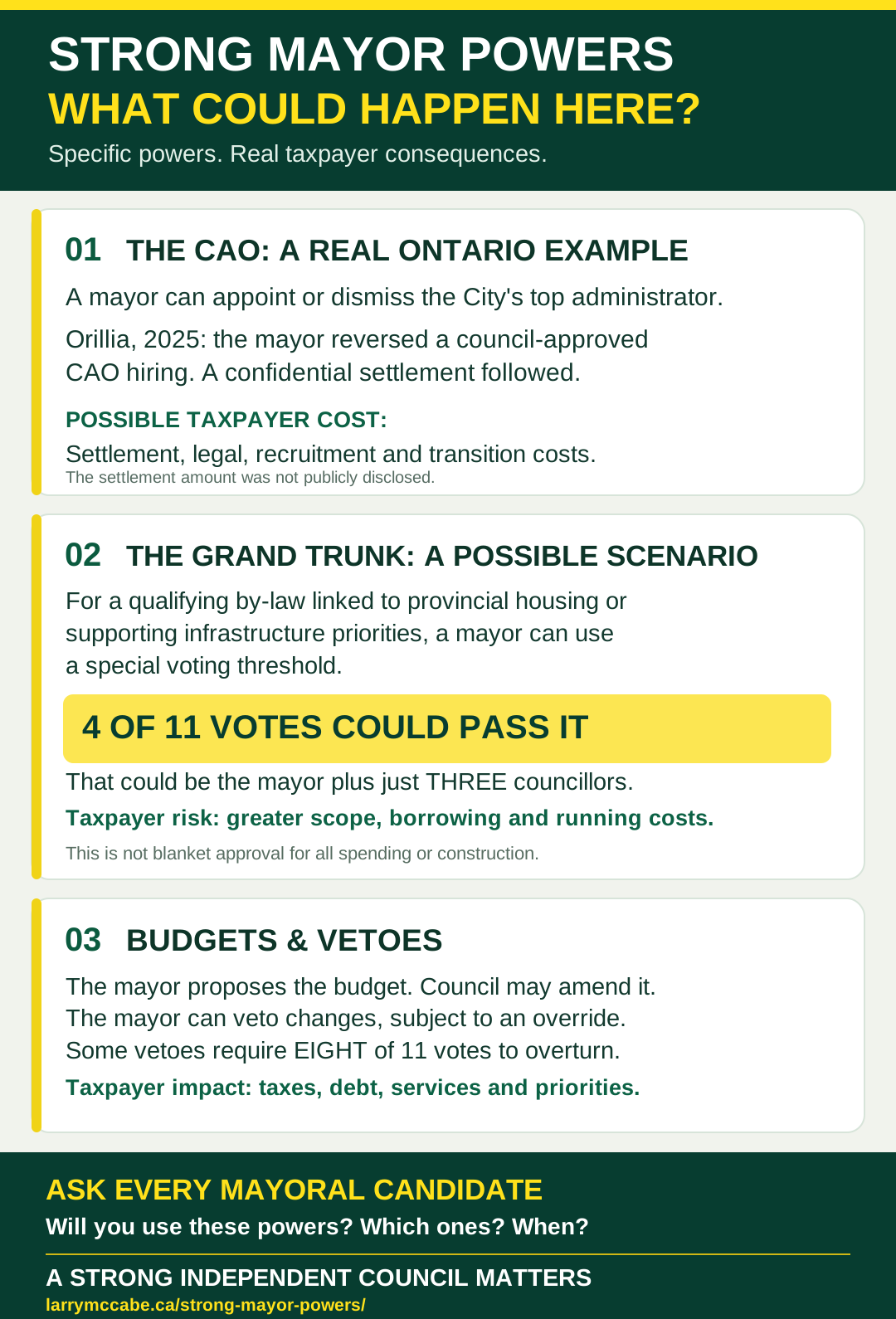
Strong mayor powers in Stratford: CAO dismissal and Orillia's confidential settlement; The Grand Trunk hypothetical, four of eleven votes; mayoral budget and veto powers.

This is not theoretical power.

Ontario's strong mayor law gives certain mayors powers over staffing, budgets, vetoes and specific by-laws tied to provincial priorities. Some are exercised without a council vote. Others can pass with substantially less than a majority of the full council.

Stratford has eleven council members: the mayor and ten councillors. For a qualifying provincial-priority by-law, the legal test is more than one-third of all members. That means four votes, potentially the mayor and just three councillors. It is not a general rule for every by-law or expenditure.

The questions are not only whether a candidate would use these powers, but which ones, when, and to what effect on taxpayers.

Read Ontario's official guide to strong mayor powers →

1. Changing the CAO

What the law allows

The mayor may appoint a chief administrative officer and exercise associated appointment and dismissal powers. The CAO is the City's senior administrator, responsible for coordinating municipal operations.

What actually happened in Orillia

In April 2025, Orillia Mayor Don McIsaac used strong mayor powers to reverse the appointment of Trevor Lee, whom council had approved as the City's incoming CAO. In May 2025, Orillia and Lee confirmed an amicable, confidential settlement. The amount was not publicly disclosed. This was a reversal of an incoming appointment, not evidence of a published severance figure.

Why taxpayers should care: a disputed leadership change can give rise to legal, settlement, recruitment and transition costs. No reliable dollar amount is available for Orillia's settlement, so it should not be represented as a known cost.

OrilliaMatters, May 20, 2025: confidential settlement → · Orillia's public discussion of the powers →
2. The Grand Trunk

A possible provincial-priority scenario — not an announced plan

Suppose a future mayor argued that a proposed Grand Trunk redevelopment by-law would advance a specified provincial priority such as housing or infrastructure that supports housing. The mayor could propose a qualifying by-law under the relevant legislation and ask council to vote on it.

Just four votes of Stratford's eleven members could pass such a by-law. That could be the mayor plus three councillors. This threshold applies to qualifying by-laws under the provincial-priority process — not automatically to an entire project budget, procurement contract, construction approval or every step of a redevelopment. Other statutory, planning, consultation and funding requirements may still apply.

Why taxpayers should care: any expansion of the project's scope or increase in City commitments could affect borrowing, debt service, operating costs and what other work the City can afford. These costs would have to be established through actual proposals and financial analysis; none is assumed here.

Ontario Municipal Councillor's Guide: provincial-priority by-laws →

3. Budgets and vetoes

Who sets the priorities?

Under the strong mayor framework, the mayor proposes the municipal budget. Council may amend it; the mayor has a veto process over amendments, and council has an override process. For certain mayoral by-law vetoes, the threshold to override is two-thirds of all council members — eight of Stratford's eleven votes.

Why taxpayers should care: the budget affects property taxes, services, long-term capital priorities, borrowing and what gets deferred. This is not an assertion that any particular candidate would increase taxes.

Ontario's guide: budget process and mayoral veto powers →

Four questions for every mayoral candidate

  1. Which strong mayor powers would you use — and when?
  2. Which delegable powers would you return to council or the CAO?
  3. How will you implement the adopted procedural bylaw and preserve open debate?
  4. What would you do to protect taxpayers when major projects or budgets are on the table?

A strong, independent council matters regardless of who becomes mayor.

This page distinguishes documented events from hypothetical scenarios. It is intended to explain potential legal powers and taxpayer implications, not to state that a mayor can bypass every project approval or that any candidate intends to do so. Part one published October 19, 2026. Part two added October 21, 2026.

More campaign updates →